AI-Powered Customer Experience
Turning AI from a content generator into an intelligent partner for small businesses.
Role
Director of Product Design
Team
Product · Design · Research · Engineering
Timeline
6 months
Outcome
16-point improvement in customer retention among AI-engaged customers
Responsibilities
Small businesses did not need more AI. They needed less work.
The market was racing to add generative features. For a small business owner running marketing alone, another blank text box was not relief, it was one more thing to operate.
The opening was not better generation. It was fewer decisions, less setup, and less time between intent and a finished campaign.
Customers changed how we thought about AI.
Four themes came back consistently, and none of them were about generation quality.
“Help me decide what to do next.”
The hard part was not writing. It was knowing which campaign was worth sending at all.
“Do not make me start from scratch.”
A blank prompt transfers the work back to the customer. A starting point does not.
“Understand my business.”
Generic output reads as generic. Context the product already held was going unused.
“Keep me in control.”
Willingness to use AI depended on being able to review, change, and reject it.
The research pointed at a different product entirely.
AI Content Generator
Produces copy on request. The customer still decides what to make, when to send it, and whether it is any good.
AI Business Partner
Starts from what the business already is, recommends the next move, and carries the work forward with the customer in the loop.
Helps with the task the customer already started.
Recommends which task is worth doing next, and why.
Carries multi-step work forward, pausing for approval.
Creating guardrails for an emerging experience.
AI features were being proposed faster than any single team could review them. Principles were the scaling mechanism: a shared bar that let teams move independently without the experience fragmenting.
Start from something, never nothing
Every AI entry point opens with a starting position rather than an empty prompt.
Earn context before asking for it
Use what the product already knows about the business before requesting input.
Recommend, do not decide
AI proposes the next move. The customer confirms it.
Show the reasoning
Every recommendation carries a visible reason it was surfaced.
Keep the exit visible
Any AI path can be abandoned at any point without losing work.
Match the mode to the moment
Support both the customer who wants direction and the one who wants refinement.
Meet customers where the work happens.
The assistant was not given its own destination. It sits alongside the task, in the surface where the customer was already working.
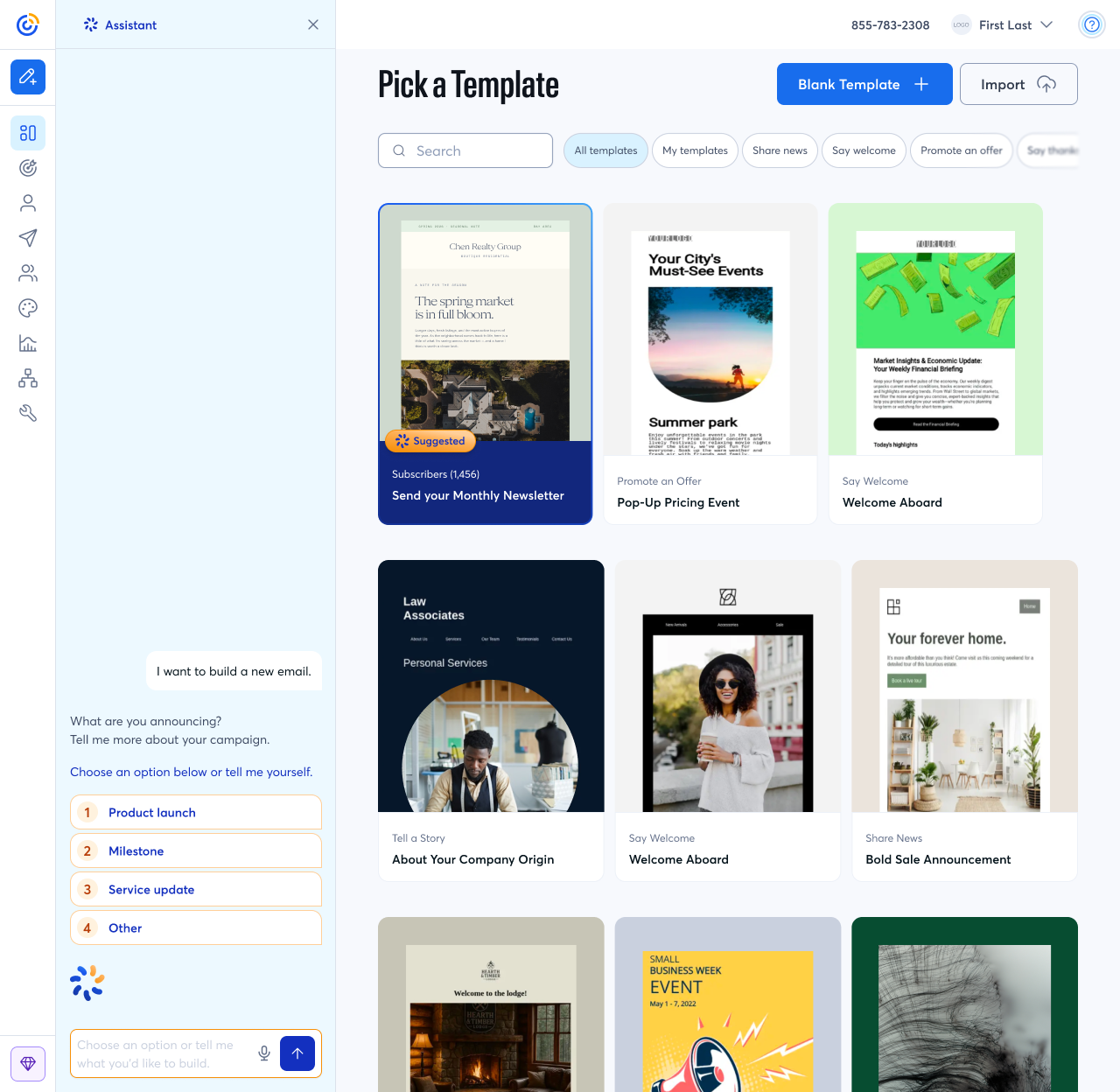
Turn intent into a starting point.
The customer states an intent in plain language. The assistant converts it into a small set of concrete choices, then uses audience and brand context to recommend a specific template rather than returning a blank canvas.
- 1The customer states intent in their own words
- 2It becomes a few concrete choices, not a blank prompt
- 3Free text stays available, so the guided path is never a cage
How this decision was made
- Research
Do not make me start from scratch.
- Principle
Start from something, never nothing.
- Decision
Intent becomes guided options and a recommended template.
- Outcome
Fewer abandoned starts on the path to a sent campaign.
One assistant. Different contexts.
Small business owners do this work between other jobs, often on a phone. The assistant keeps the same model of help at every size, changing how much it shows rather than what it can do.
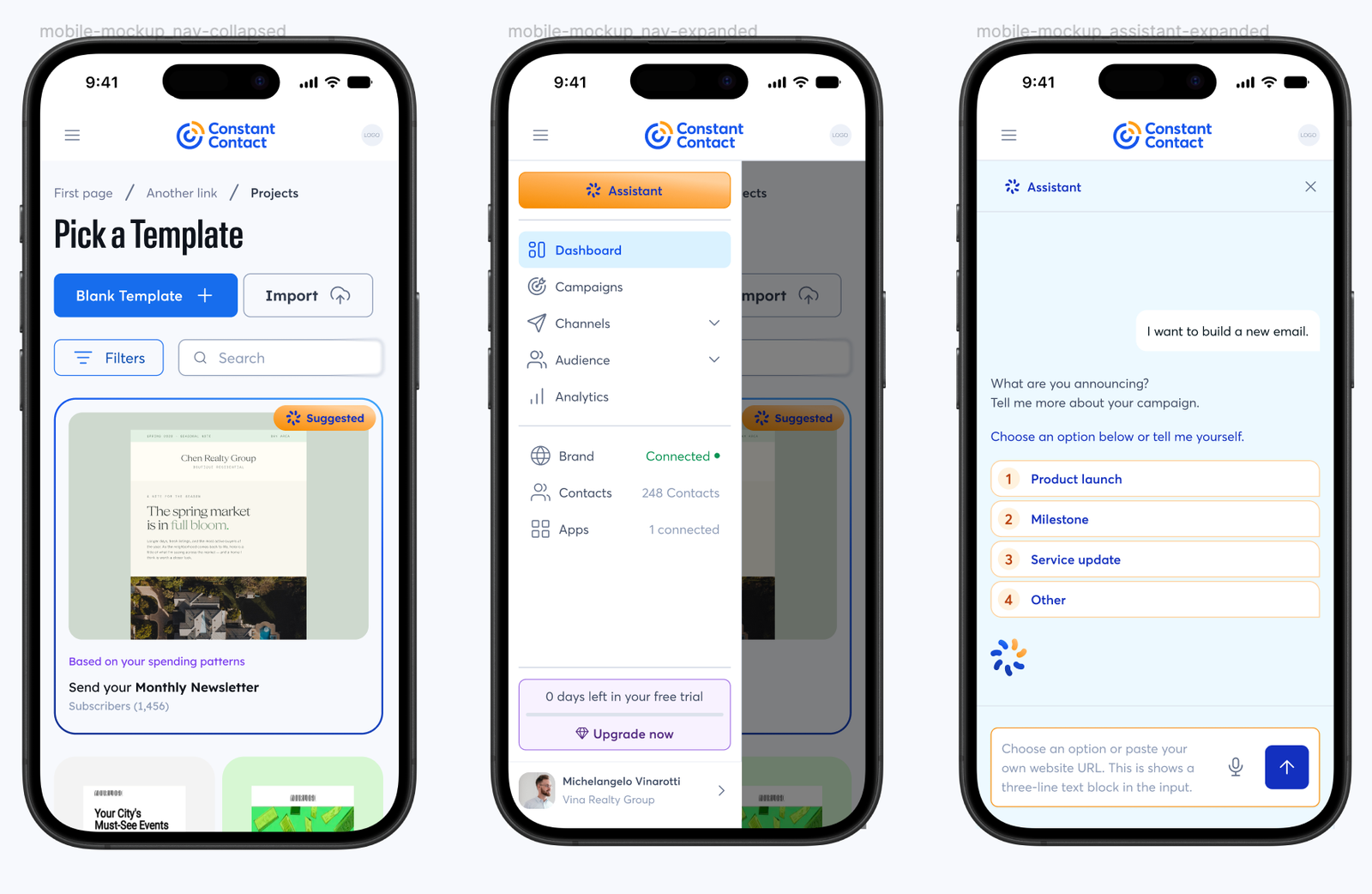
How this decision was made
- Research
Help me decide what to do next.
- Principle
Match the mode to the moment.
- Decision
The same assistant model adapts density instead of capability.
- Outcome
Continuity for customers who start on one device and finish on another.
Two customers, asking for opposite things.
“Tell me what to do.”
Wants a confident recommendation and one clear next step. Too many options reads as no help at all.
“Help me do this better.”
Already has a plan. Wants refinement, alternatives, and the ability to overrule anything suggested.
How this decision was made
- Research
Keep me in control.
- Principle
Match the mode to the moment.
- Decision
A single assistant that can lead or assist, rather than two separate features.
- Outcome
One experience that holds up across very different levels of confidence.
AI that knows when to help.
Usefulness depends on timing as much as capability. This ladder gave the organization a shared way to talk about how far a given AI experience should go, and when going further would feel like interference.
- 01
Reactive
Responds when the customer asks.
- 02
Contextual
Adapts to the surface and the task at hand.
- 03
Proactive
Surfaces the next move before it is requested.
- 04
Orchestrated
Coordinates multi-step work across the platform.
How this decision was made
- Research
Understand my business.
- Principle
Earn context before asking for it.
- Decision
Recommendations draw on audience, brand, and behavior the product already holds.
- Outcome
Suggestions specific enough to act on rather than dismiss.
AI recommends. Humans approve.
Nothing reaches a customer list without an explicit human decision. The approval step is not friction to be optimized away, it is the reason the rest of the system is usable at all.
- 01
AI recommends
A specific next move, with the reason it was surfaced.
- 02
Customer reviews
Everything remains editable and refusable.
- 03
Customer approves
The explicit decision that releases the work.
- 04
Campaign sends
Results feed the next recommendation.
How this decision was made
- Research
Keep me in control.
- Principle
Recommend, do not decide.
- Decision
An explicit approval gate on every AI-initiated action.
- Outcome
Adoption that holds, because the customer is never surprised.
Retention moved.
Measured against customers who engaged with the AI experience, compared with those who did not.
+ pts
Improvement in customer retention
Among AI-engaged customers
%
Higher average monthly revenue
Among AI-engaged customers
Leading the shift.
“My role was not to design a chatbot. It was to help define how AI should behave across the customer experience.”
The work that mattered most was not screens. It was building the shared language, the principles, and the review bar that let many teams ship AI independently without the experience pulling apart.
02 · Constant Contact